Sunday, January 14, 2018

The Tide Pool

The Tide Pool, 6X6" Oil, painted at Assateague Island, VA
This is my favorite painting from 2017, it was a gorgeous day on the beach, I had intended on swimming and then painting but the water was so rough only a few surfers were in the water. The tide pools were the only safe place to let the kids get wet and play. I set up my easel near by and spent the day there.

Monday, September 12, 2016

Backing a Canvas

As promised here is my first post regarding  My collection of art. This is a painting by Frank Liljegren,  The Coffee Pot, 14X18 Oil on Canvas. Many of these posts will be about ways to conserve or protect your art. By no means  comprehensive in any sense of the word. I am not a art restorer or art conservator. I do however work in a related field of architectural restoration so I have a understanding of some of the things that could and sometimes do go wrong.
Much of what I know has come directly to me through collecting art and framing my collection.
At first I was going to go chronologically through my collection. but I'm preparing one of my own paintings for a group show and am going to employ this very important preparation for my own work. So for me this is what's current.

I first learned about this valuable technique of backing my canvas's from my first real art instructor Mr Frank Liljegren formerly of New York, currently of St Mary's Ohio. I don't know if he still teaches there, but he is a master painter and a master teacher. Mr. Liljegren has a wealth of knowledge and never holds that knowledge back. His students walk away well prepared in the skills of the artists craft, as well as a passion for it. Franks love for art is infectious and his class's were electric with excitement for learning.

It was Frank that inspired me to move to New York City, he spoke so fondly of his time studying, and later teaching at the Art Students League of New York, that I just had to go.
Before leaving for New York I  purchased one of Franks paintings, a gorgeous oil painting called The Coffee Pot. It was unframed at the time. When I went to pick up the painting from Franks studio, he had packed it very securely in a box for me and also handed me a large sheet of mat board with a hole cut into the center that was a 6.5"X4" rectangle. He also had a typed label with his name the name of the painting, medium and size adhered to the back of the mat board.
Frank advised me to bring this board with me to the framers and have them attach the board to the back of the frame. He was very precise in telling me to have it attached to the frame, not touching the back of the canvas, and that the hole/window in the board was so the canvas would have air circulation, it needed to be able to breath. This he said was very important to protect the painting from the risk of punctures or dents from the back. I have also learned that the canvas needs to have the circulation to protect against mildew forming due to humidity in the air.


The mat board is something that can be purchased from most art stores. The 100% acid free is more costly, but its what I would recommend for most applications. The less expensive partial acid free is only acid free on the back side, and it is only a veneer of acid free paper. That is the side that should always face the art work. Please do not use cardboard, only in a pinch to travel, or a temporary solution for added protection. I use cardboard for many tasks around the studio, but not for the framing of valuable works of art, and never for storage of works on paper.

For my group show, where we are displaying works unframed I use foam core for the back, it is a temporary but much needed added protection. This gives my painting a better chance of coming back to me unscathed. It will be shuffled about by many hands both skilled and unskilled in the handling of art. The foam core is not acid free but will work as a short term solution. I wont find the bulging impressions of other peoples smaller paintings having slipped behind and pressed against the back of my work during the installation or dismantling of the show. Foam Core boards can also be purchased in an acid free (archival) variation.

In the out of print book "Is Your Contemporary Painting More Temporary Than You Think?" The author Louis Pomerantz has a section on protecting a painting with backing, though he does not include a circulation window in his instructions, It is still a book I very highly recommend, it brims with information to artist and collector. You can still find this book online.


This last picture shows my temporary protective backing on my unframed canvas. A little crude, but it will do the trick, I also think the opening is too small for this size canvas. I used tape reinforced with staples to secure the board in place. A more permanent way to hold in place would be to use 1/8th inch brackets or some other hardware, rather than, or in addition to tape.
I hope this was helpful. Happy collecting!


Saturday, July 23, 2016

Central Park Tree

This little 8X10" Oil was painting in Central Park NYC, Its a tree along a trail path that skirts the reservoir. This was during pollen season, so large portions of the water were coated in pollen. In the background are the rental boats lined along the opposite bank.

Monday, November 23, 2015

125th Street


 Fairway, 8X8" Oil on panel, New York City

Thursday, August 13, 2015

Golden Marsh


This painting of a Marsh was made in April of this year, too early for the greens to have started showing. The golden grasses are among my favorites. Oil on panel, 6X6'. Eastern Shore, Maryland.

Thursday, July 30, 2015

A Saranac Scene

This is a 6X8" Oil on panel, available in my Daily Paint Works Gallery. I painted this in June of 2015 during a misty summer day in the Adirondacks.

Monday, January 19, 2015

Oscar Harmon Barrett: The Importance of Provenance


Oscar Harmon Barrett was a well known and highly respected Producer of Pantomime in Victorian England, he was also a very talented artist and musician. I have a landscape painting of his on my wall.
I've had this painting for 42 years and I never tire of it. Its a watercolor painted in North Devon England in 1925, titled 'On The Lymn (Lynn)'

I was still in my teens when I first traveled to England, that is where I bought my second painting, then my 3rd, 4th and so on.. I was hooked!
Most of my early collection has been of  English Watercolors from the turn of the century. Many pieces were works on paper, framed under glass. I would remove the works from the frames and even if I kept the glass and frame, I would always replace the mat board and backing. Making sure to replace with only acid free paper and mats.
Often I'd find nuggets of information hidden out of view on the back of the art or behind the original mat board, on the face of the art, but out of view. Of course this information would then be added onto the back of any new backing board or paper.

This is how I came to own the original Oscar Barrett painting 'On the Lynn'. I was hiking around the English countryside and it was during a time when people did not appreciate the watercolor. The antique shop owners would tell me how everyone wanted oils, the watercolor was out of favor at the time. It would be 40 years before I could find out who Oscar Barrett was.. thank you Google and thank you to his great grand daughter Hope Barrett for writing the e-book 'Discovering Oscar'.

 The Provenance of a Painting.
Not all artists sign their paintings on the front, some sign on the back, some add information such as location and date if its a landscape. I've even seen time of day and number of piece as well as title. As an artist develops and learns the information they provide may change over time, even the signature itself, I've seen symbols, initials, and full on signature first middle and last name included. How and what and sometimes where an artist signs is all part of the signature, though not always consistent.
The sooner an emerging artist can nail down their signature the better. Better I say for the collector, and for the legacy of the artist.
Signature is a big deal, unless you as an artist are happy to have your paintings cataloged as "by unknown".. I didn't think so.
Firstly Provenance is the origin of the work, and then it's about the history of ownership. I see it also as pieces to a puzzle. Evidence of it's history.
I am not that collector who needs to worry about forgeries and high dollar gains or loses. My collection is about being surrounded by beautiful paintings by artists who've left a legacy of their talents. The signature and any additional information gleaned from a previous owner is to be passed on, insuring that the connection between art and artist remains.
That's the beginning of the provenance. Making a notation, a documentation as best you can, for the next person in line. This adds to the richness of the experience of collecting. Talk to any collector, and they love to talk about the art.
You buy a painting from a living artist, you are a patron and a collector. A simple thing that you can do, is copy down any information that is on the back of the piece, and when you have the piece framed have the framer glue that information to the back of the frames backing paper. I recommend you also include where and when you purchased the painting. Never write on the back of the art work or modify it in any way, unless it is your own work, hands off.
If I have news clippings about the artist, a review, or card for a gallery show, I put it in a clear sleeve or envelope with the artists name attached to the back of the frame. This is my way of making sure the art has a documented history. I also sign and date my notes. I think of myself as a steward of these 'one of a kind' treasures.
The provenance can add value and interest, it can add to the story behind the piece, the artist and in the case of a landscape, the place.


When I first purchased Oscar Barrett's landscape painting, I only knew it was painted by O.B. Not until I removed the frame could I see all the information he had provided, just below the image.
It would be another 40 years before I could find any more information about him. Now I have photos of the artist, stories and historical facts. When I recently re-framed this piece I had the new mat cut to reveal Oscars handwritten notes.

I hope this was helpful to you. If you have original art, remember that it's the only one there is. It is in your stewardship to preserve and conserve for future generations.

Monday, November 17, 2014

The Flumes

I painted this little 6"X8" oil during the 2014 Saranac Lake Plein Air Competition in the beautiful Adirondacks, New York. It has become one of my new favorite places to paint. The area has provided me with many rock painting opportunities.

Friday, October 10, 2014

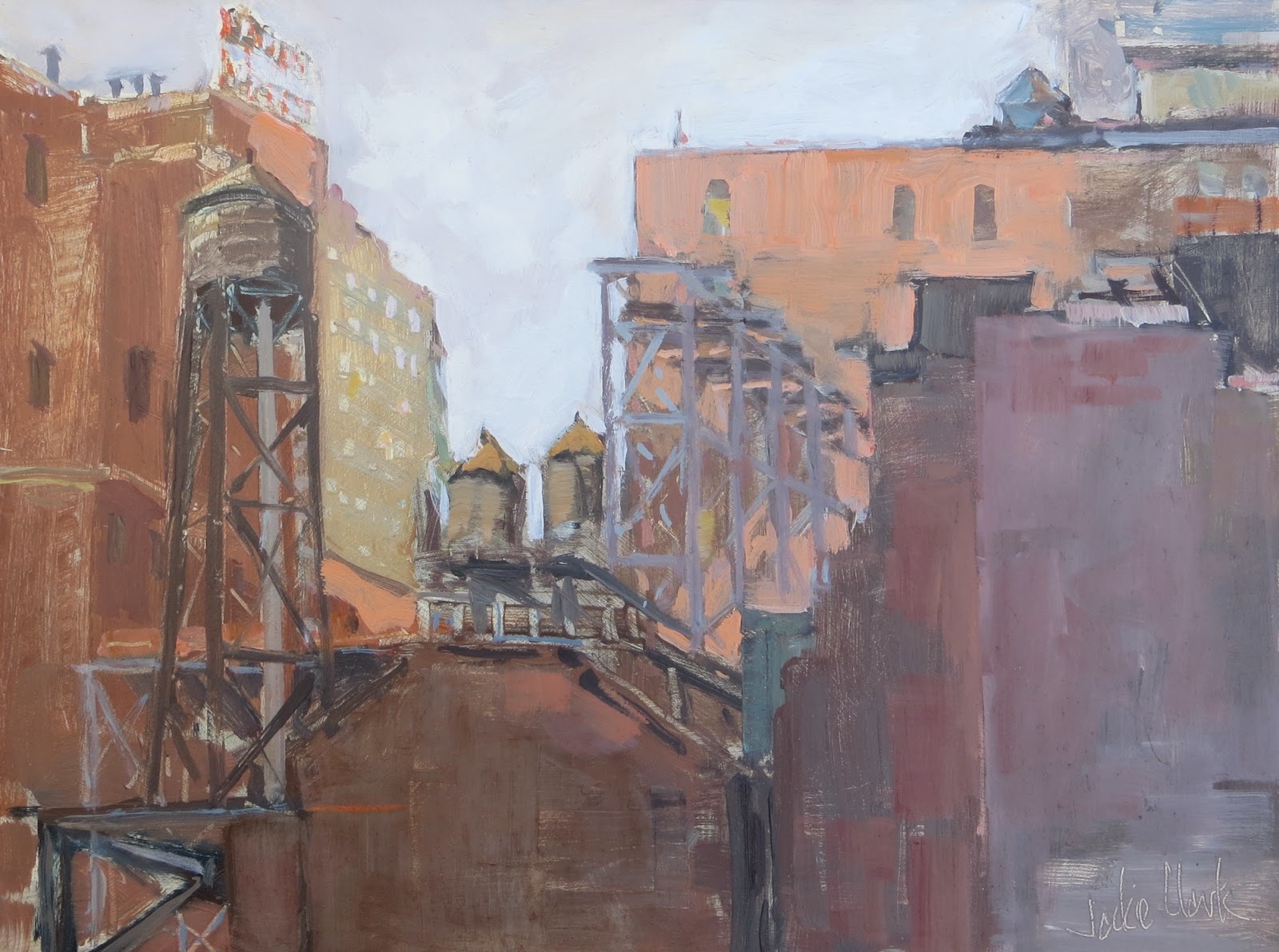
Water Towers

This is a recent plein air cityscape I did in New York. This is the view from the sidewalk at 57th Street looking East towards the Art Students League, a view soon to be obscured by a new high-rise building.

Saturday, July 26, 2014

Blackwater Refuge: looking back

Painted on the beautiful Eastern Shore of Maryland as part of Plein Air Easton 2014. Blackwater Refuge: looking back, 18"X12" Oil on Panel.

Saturday, May 3, 2014

It's Plein Air Season 2014!

It's that time of year when here on the East Coast we pretty much have our schedule's for the season nailed down. Here's a painting that I just recently did during Paint Snow Hill 2014. It's one of my favorite events. A great time to catch up with friends. I think of these events as "play dates" with my fellow plein air art pals. We do have fun!

Sunday, April 6, 2014

Best Light

Best Light 5"X7" Oil on Panel. We had new bulbs in the lamps and the light was good, therefore the title, Best Light.

Saturday, March 8, 2014

Purple Background

More from The Cold Studio, 7"X5" oil on panel. Betty on a Purple Background.

Sunday, January 19, 2014

Girl Seated and Some Thoughts on Pricing.

Here's a 7"X5" oil on panel painting I did a couple weeks ago, its one that I have kept back for my own collection (for now). I'm thinking how nice it would be to have some of these in a gallery setting.
I've been very experimental with pricing, and am now easing the prices up, they are still very low, but will be going up again in time. As always If I put a painting on auction that is the lowest price available. The auctions do not renew past the first week. After the auction is over the price goes up to a buy it now pricing.

Sunday, January 5, 2014

Betty in Red

Betty in Red 7"X5" Oil on Panel.

Tuesday, December 24, 2013

The Cold Studio

This is a 7"X5" oil on masonite panel. Available in my Etsy Store.

Saturday, December 14, 2013

Hand on Hip

Here's a recent 7"X5" oil painting I did during sketch class. It's available at Daily Paintworks now.


Saturday, November 2, 2013

Bangs Standing

Bangs Standing, 7"X5" Oil on gesso board.
I've painted so many of these small paintings, that it's harder to come up with a name. And I'm not yet willing to convert to a numbering system, the titles are more for me to know one painting from the other. This model has been tagged Bangs by me because she has lovely hair and sports bangs, or as the Brits would say fringe.

Friday, October 25, 2013

Sitting Side View

Andrea Sitting Side View 7"X5" oil on panel

Walking

"Walking Nude" is a 6"X6" oil painting on a panel. I like the simplicity of this pose, and chose to scrape away some of the paint from the background field to add emphasis to the action of her movement. Thus opening a space for her to move into, so to speak.